Reciprocity is the experience of giving and receiving care, attention, and trust. It is the recognition that relationships move in both directions. American culture’s strong emphasis on independence can sometimes get in the way of growing reciprocity. However, we believe that one of the most underrated human capacities — reciprocity—could offer us a healthier, more connected life.
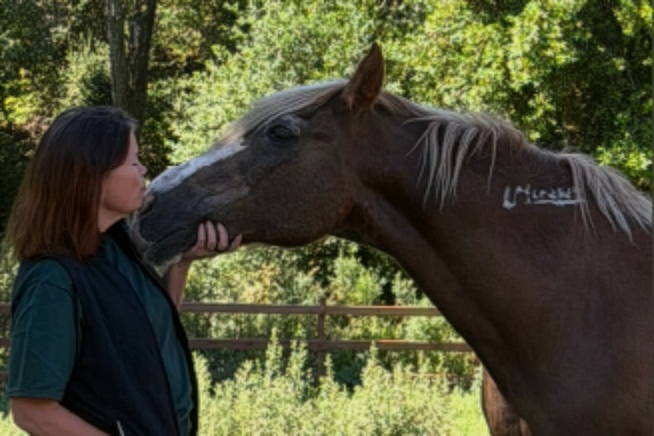
At Connected Horse, we’ve been learning from our horses, and we see the emotional benefits of reciprocity with the herd and the people around them again and again. The most meaningful interactions emerge when participants become curious and pay attention to how the horses are interacting. The horses respond. We respond to the horses. The horses offer information. We listen. We adjust. Connection develops in the space between us.
That is reciprocity in action.
The Myth That Doing It All Alone Is Expected–Embracing Reciprocity
Independence can be incredibly valuable. The ability to make choices, advocate for ourselves, solve problems, and maintain agency matters deeply. But independence becomes problematic when it turns into the belief that needing others is a failure. This is especially true for older adults, who carry the stigma of aging, and often fear being dependent or losing a sense of self. How can reciprocity and community-building help us build interdependence in a way that feels less like decline and more like normalizing the need for one another?
Caregiving can easily become one-directional. Over time, this dynamic can become exhausting and emotionally painful—especially when the care partner begins to feel that their identity has been reduced to what they do for someone else.
But even when a person needs substantial assistance, the relationship does not have to become one-way. Reciprocity might look different than it once did. A person living with dementia may no longer be able to help with daily tasks, make plans, or remember the details of a shared history. But they may offer a smile. A touch. A moment of humor. A look of recognition. A willingness to sit together. They may offer the caregiver a moment of presence.
Can the care partner pause to receive it? This is an important shift. We’ve met participants who needed to reshape a relationship that, for decades, relied on verbal recognition and intellectual curiosity. As dementia progresses, that kind of connection and communication is no longer possible in the same way. They practiced becoming more aware of body language and sought out activities involving physical, more kinesthetic forms of connection.
One of the most painful assumptions surrounding dementia is that as abilities disappear, the person’s capacity to participate in relationship disappears with them. It doesn’t disappear—it takes on different forms. The language, memory, roles, and feedback may change. But the human need—and capacity—for connection remains. Reciprocity does not require equal abilities. It requires mutual participation. When we pay attention to these forms of communication, we discover that the relationship is still alive.
Horses Understand the Language of Reciprocity
Horses offer us a remarkable model for this. Horses do not care whether we are independent, whether we can communicate verbally, or whether we know anything about horses. Horses care whether we are present.
Horses are exquisitely responsive to changes in posture, breathing, tension, movement, attention, and emotional energy. They continuously gather information about what is happening around them: is it safe, are people welcoming? When we approach a horse, we enter a relationship. We cannot simply impose our wishes and expect genuine connection. As Claudia Sonder, DVM, says, a horse that doesn’t feel connected or safe when someone approaches to clean their hooves or brush them will say, “We don’t do it that way.” It is how we approach and engage with a horse that leads to collaboration and connection.
We have to notice. We have to adjust. We have to be responsible for the energy we bring to the relationship. A horse notices us. One of our participants summarized it best: “It’s the first time I felt accepted. I felt like the horse knew I needed him, and he looked relaxed and calm in my presence—it felt good for everyone.”
At Connected Horse, we have an opportunity to think differently about what it means to support people living with dementia and families. Not simply as a problem to solve or a set of needs to meet. But as relationships to nurture.
